

 Tweet
Tweet
After understanding Wardenclyffe and Tesla's view on electricity, I thought that given the proper equipment it should be easy to proof the existence of ether, and actually make it visible.
I have come up with this experiment:
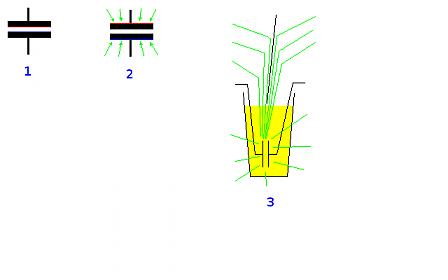
take a HV capacitor and submerge it in thin parafin oil
the leads of the cap have to be made accessible outside the oil
using a diode and any suitable HV source you charge the cap
and using a spark gap you discharge it when it is full
The idea is that inside the cap there is "charge without voltage" (to put it in a Tesla-for-dummies-manner). When the cap discharges, this charge gets out of the cap and finds that it does not have enough tension (in the same Tesla-for-dummies-words).
So this tension (ether stress) is attracted from the environment.
To make this visible we suspend a pointed conductor as close as possible to the oil surface, but not touching it. This conductor is not connected to anything its only purpose is to create a point on the oil surface where electric effects are more easily produced than anywhere else on this surface.
A much greater part of the attracted ether will now enter the oil near the point of the conductor and drag air along with it. The air pressing on the oil surface is clearly visible with voltages as low as 2000 Volts. But it is still difficult to get it on camera.
My attempts can be seen here and here
I figure that when someone has access to a better capacitor, say 20 KV or more, a much more convincing video could be made.
Of course the capacitor plates are also moving during a disruptive discharge so the leads also move a little. The video should make clear that there is an effect created through the suspended conductor.
Anyone care to give it a try?
Ernst.
I have come up with this experiment:
take a HV capacitor and submerge it in thin parafin oil
the leads of the cap have to be made accessible outside the oil
using a diode and any suitable HV source you charge the cap
and using a spark gap you discharge it when it is full
The idea is that inside the cap there is "charge without voltage" (to put it in a Tesla-for-dummies-manner). When the cap discharges, this charge gets out of the cap and finds that it does not have enough tension (in the same Tesla-for-dummies-words).
So this tension (ether stress) is attracted from the environment.
To make this visible we suspend a pointed conductor as close as possible to the oil surface, but not touching it. This conductor is not connected to anything its only purpose is to create a point on the oil surface where electric effects are more easily produced than anywhere else on this surface.
A much greater part of the attracted ether will now enter the oil near the point of the conductor and drag air along with it. The air pressing on the oil surface is clearly visible with voltages as low as 2000 Volts. But it is still difficult to get it on camera.
My attempts can be seen here and here
I figure that when someone has access to a better capacitor, say 20 KV or more, a much more convincing video could be made.
Of course the capacitor plates are also moving during a disruptive discharge so the leads also move a little. The video should make clear that there is an effect created through the suspended conductor.
Anyone care to give it a try?
Ernst.

Comment