
This forum is preserved as a permanent archive. The community continues at eMedia Press.

Announcement

Collapse
No announcement yet.

Huge aerial antenna project

Collapse
X
 
  • Filter
  • Time
  • Show
Clear All
new posts

  • Huge aerial antenna project

    It is my understanding from the general consensous of this board that a very large antenna or pan is needed to get any amount of reasonable electricity to be practical for useage in an aerial setup. I have access to a very large steel roofed building that is shaped like a cross if seen from the sky. It is made of 8 Atco trailers with a hallway in between and a common area in the middle. It is also raised because of the sloping ground. This is part of an old logging camp turned mining camp. The wiring system is all underground and was supplied by a pelton wheel turbine of 60kva normal running and can be set to 160kva.Its a Thompson and Howe installation. The turbine has been out for repair and in the mean time I still need power to run a few things.So my thoughts are to use the roof as the antenna because it has some major square footage for surface area, and I would use the ground wire in the ground as the grounding point. Obviously I will be dealing with high voltage of which I have some experience.I only have basic meters for measuring tools digital and analog. Who has experience in this sort of research or projects and what can you suggest for a circuit to drop the volts to a useable level? I have a fair amount of stuff here at my disposal. I can report back with the results as I work on it.I want to put in a kill switch for total shut off .reason being this area I am in is in the mountains of British Columbia.There are few thunderstorms around and You always know they are coming long before they hit the area.The rocks are heavy in pyrites,magnetite and hematite,shists and granite.There are pyritic ores behind me and in front on the next ridge that are pure pyramidial crystals of about 1/4" in size in shale.Usually there are fires every year from the lightening hits.So I need to shut the system down when the storms are coming which is about 2 weeks total in the year.
    I have a power shut off switch already.lots of wiring,a few radio style tuning caps and one big one from a piece of navy equipment.and a lot more parts to play with.So if any one is interested in working with me where by I do the work and you do the suggesting,internet research,suppling info,etc then let me know and we can see what kind of trouble we can get into.
    Thanks for any input.
    Andre
  • #2
    Starting Point

    Hi Andre,

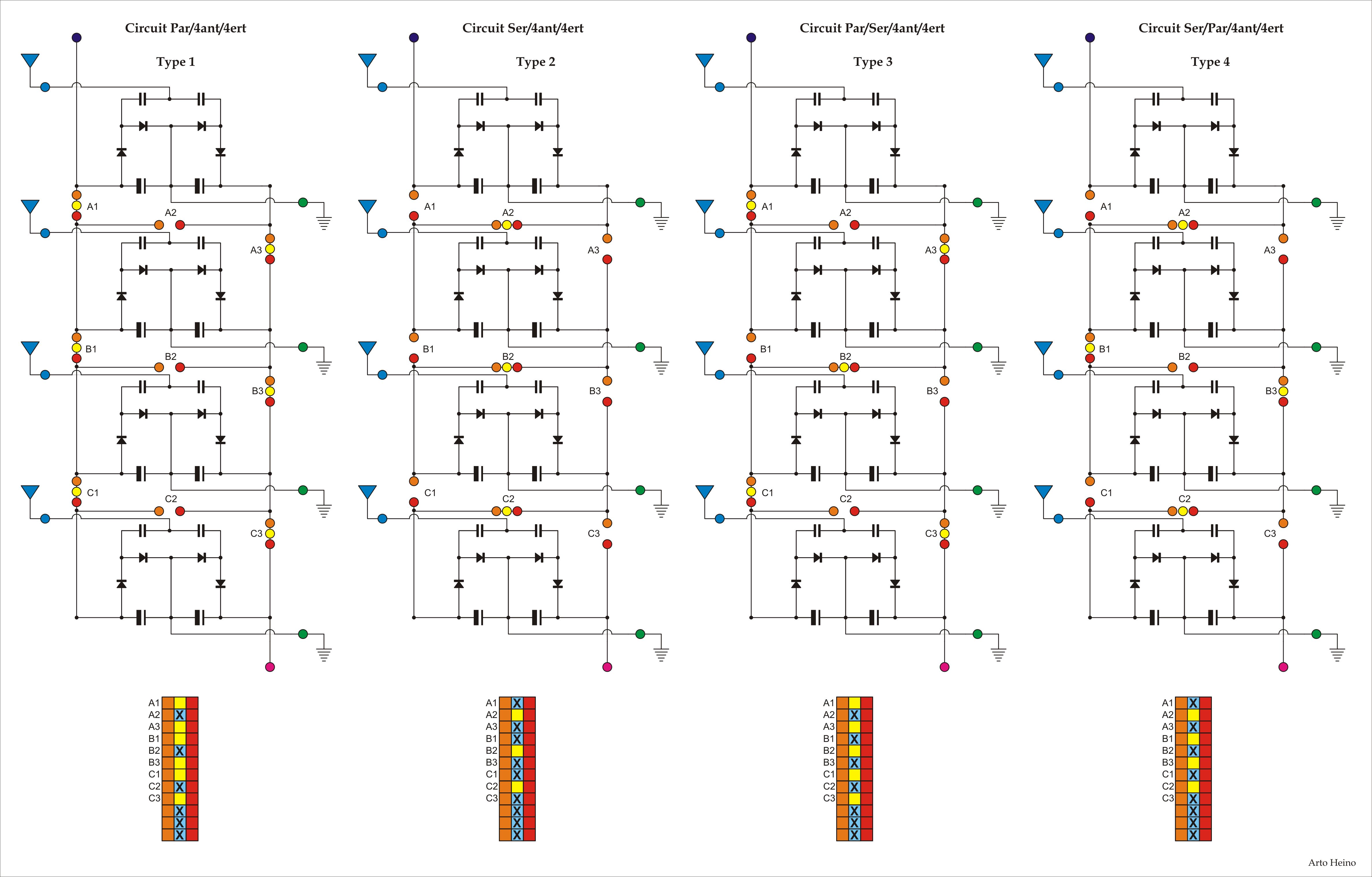
    It looks like you have some big possibilities available, I can only suggest trying out the basic collectors circuits, such as the one I have explored.

    Here is a fun project that will give you about 0.5/0.6/1.58 volts of radiation energy reception. The analogy is like a putting a microphone in a noisey environment and converting the noise into ene…


    Good luck
    Regards Arto.

    Comment


    • #3
      There are numerous methodologies explored here:


      but I think you will need your aerials to be insulated from the ground which might be achievable with quite a lot of work.

      Comment


      • #4
        circuits and grounding

        On those circuits any micro amp readings?
        The ground appears to be one cable running down the side into a stake in the ground.there also is a grounding on every breaker panel inside.The are 15 buildings here all connected with the ground going back uphill to the turbine house.Large thick aluminum wire runs buried to carry the current.All the buildings are on wood logs as this is an old camp it has to be so called temporary so that its easy to return the area to as it was before.Right bow its so hot here the last few days it makes it tough to get anything down.until the evening when its cooler. 34 plus degrees at 75 % humidity. Isnt that Florida weather?
        Herman

        Comment


        • #5
          also

          The chapter 7 of PJKs book Im familiar with thanks.Thats what kind of gave me the idea.Also I can remember as a kid going over to a friends house and putting a string of neon lights all around his metal window frame as a ground and they would all light up.It looked like a Christmas decoration.It was pwer from those high voltage towers nearby.The lived there several years and later most of the family suffered from all kinds of medical problems because of the radiations.
          Andre

          Comment


          • #6
            Originally posted by IKNOWNOTHING View Post
            It is my understanding from the general consensous of this board that a very large antenna or pan is needed to get any amount of reasonable electricity to be practical for useage in an aerial setup.
            That's true but the devil is in the details.

            I have access to a very large steel roofed building that is shaped like a cross if seen from the sky. It is made of 8 Atco trailers with a hallway in between and a common area in the middle.
            One of the requirements for a system like this is that the elevated plate be completely electrically insulated. The system collects energy from charged particles constantly bombarding the plate. The following is a link to one of Nikola Tesla's patents for collecting radiant energy. It will be well worth your time to read it carefully.
            APPARATUS FOR THE UTILIZATION OF RADIANT ENERGY

            The insulation serves two purposes. The first is to prevent the charges collected by the plate from neutralizing with charges in the air surrounding the plate by acting as a dielectric and thus separating the charges. Not only does the entire plate need to be insulated with dielectric material but all of the connections and wires connected between the plate and the device driven by the collected charge must be insulated as well. That includes the upper 3 or 4 feet of the ground rod because the charged particles penetrate the top portion of the soil as well.

            The second purpose the insulation serves is to prevent any sharp corners or burrs on the elevated plate from being exposed to the air. Those corners or burrs will ionize the air around them and the ionized air is more conductive than normal air so lightning will take the more conductive path to the plate. That's exactly how the point end on a Franklin style lightning rod works - it essentially attracts lightning with the ionized air and then routes it to ground, thus protecting the structure which it is above. Those lightning strikes would destroy your equipment and anything attached to it if the plate is not totally insulated. That would definitely be important in your location as you describe it.

            The higher the dielectric constant of the insulating material insulating the plate, the better the charge separation. So the material used to insulate the plate is important.

            This is probably a deal killer in your case because you have to remove the roofs, insulate and connect them, and insulate the connections before you could even do any testing. And the roofs can't be connected to the metal on the sides of the trailers or any metal studs if the trailers use metal wall framing.

            It is also raised because of the sloping ground.
            The height of the elevated plate in Tesla's patent is more about height above sea level than height above ground because the higher the elevation the less air the charged particles have traveled through to reach the plate and so more charged particles will reach the plate rather than colliding with air molecules and/or airborne particulates.


            This is part of an old logging camp turned mining camp. The wiring system is all underground and was supplied by a pelton wheel turbine of 60kva normal running and can be set to 160kva.Its a Thompson and Howe installation. The turbine has been out for repair and in the mean time I still need power to run a few things.
            I think it would be a waste of time and money to try wiring the roofs. Save the money for turbine repairs or to upgrade the turbine.

            Obviously I will be dealing with high voltage of which I have some experience.
            That is not the case. The system only collects energy slowly and requires the best capacitors with the lowest leaked to store it as it builds up. That is also covered in the patent. Once collected it can then be used from the capacitors but, obviously, not any faster than it is being collected or you'll just drain the capacitors.

            Who has experience in this sort of research or projects...
            I have built a small one of these systems to figure out what was going on so the above is from experience, not just theory. I "back-of-an-envelope" calculated that in my location I would need about 20 acres of elevated plate to power a single family home. You might not need as much plate as that since you are in the mountains and at a higher altitude but I don't think it will be economically viable.

            If you are still interested I can provide more links for you to study. But first read the patent closely to look for pitfalls.

            Comment


            • #7
              options

              Thanks for the heads up.I am familiar with the patent but its been awhile since i read it so will reread shortly.I understand what u mean about the burrs and lightning but i was thinking if i have a shut off switch to the ground and drain any caps wouldnt this put the roof back to the same as was charge so as not to attract lightning?Also like i said lightning is so rare around here and u can smell it a mile coming.But seriously i dont want to pump a whole bunch of coin into this as u r right about better money spent else where.What i had planned is to see what I can build and test with stuff I find around here.Take some readings and such and if I can get enough power to run a washmachine during a hot sunny day thats good enough for me.I know a household actually takes more power than most people realize. Im also working on some thing else far more safer and hopefully reliable but that will take more time and money so I need to do something in the mean time.It absolutley sucks when u have to decide if u can afford to wash a load in town or not because u have to take it out of the food budget so what can u go without the next 2 weeks?Im 56 feel like 80 and trying to live on a budget that is an insult to anyone in a western country.Im a prospector and this year has been real bad for me as far as income is concerned.
              The buildings are all on wood and wood framed Yes the sides are metal but not directly attached to the roofs as they have wooden joists inbetween.If I put a meter on the roof and a side I get 0 ohms(open)
              There are three cables about a foot underground and 2 are shielded the red and black but the ground is exposed open aluminum all inside a plastic pipe and only exposed at underground boxes where u have to lift the concrete or sometimes wooden lid to get access.This camp used to be a town and is 150 years old.The buildings are mostly from 1930 to 1980.To have a working washmachine here would be a real bonus.As is it is I have no fridge,freezer,airconditioner etc.The heat is a wood stove and the cooking is a propane stove.When I get up and out in the morning I can see a bear that has hung around lately and he likes to play with this 45 gallon plastic drum in the field rolling it around.Blackberries are ripe so theres breakfast for him and me.and so life goes on!!!!ever see a hawk chase a Heron?a Heron can out fly a Hawk.All ideas, insights,experience and suggestions always appreciated.Thanks

              Comment


              • #8
                roof

                I forgot to mention the roof is all connected already by all the sheet metal so nothing need to be done there.As soon as I get my camera setup and a way of loading 3.5 floppys Ill post pix.I have an old Sony mavica still going strong and relaible when its used regularly.yeah I know im dealing with antiques but if it works i keep using it.Anyone want to buy some betas?hey I still have some 8 tracks too!!

                Comment


                • #10
                  Originally posted by IKNOWNOTHING View Post
                  The buildings are all on wood and wood framed Yes the sides are metal but not directly attached to the roofs as they have wooden joists inbetween.If I put a meter on the roof and a side I get 0 ohms(open)
                  Is it a megger meter for testing insulation?

                  That is what you need. A regular meter is not enough. Wood is inherently damp. You would be better off getting a ceramic insulator between the roof and the support. Also, each section of the roof needs to be connected to neighbouring sections by very low resistance couplings.

                  Comment


                  • #11
                    Testing and numbers

                    Lots to digest here but what I,ll do is do some tests first and get back with the results in a few days.Still digesting the Tesla patent as the wording is from a different generation so it changes meanings in English which really is a poor language for exactness.5 words can mean one thing and 5 things can mean one word and then theres the class difference as well.Thanks
                    Andre

                    Comment


                    • #12
                      Arial System

                      I know this has been a while since any one has posted but here is a circuit that is off of PJK book. there are twelve circuits. 6 on the upper half flipped horizontally positive side to positive side. negative to negative then the second half is flipped verically to line up with the ground. very compact with no space wasted.
                      i have gerber file also if wanted.

                      A modification of this circuit of Jes Ascanius’ by a developer who prefers to remain anonymous, doubles the
                      output of each module by adding a mirror image of the circuit. chapter 7 page 14 i think.

                      i could not make the circuit larger due to 500 pin limit on DipTrace i purchased but would be free to whom ever wants it, just let me know.


                      MM
                      Last edited by marathonman; 06-27-2017, 03:47 AM.

                      Comment


                      • #13
                        Cosmic rays

                        I saw an article today that backs up my conjecture that the solar wind is to cosmic rays as a cloud is to a photovoltaic collector in paragraph 6 of post #9 above.

                        CME SWEEPS ASIDE COSMIC RAYS


                        I also saw an article that reminded me of Moray's claim that when the incoming power was heard through headphones it sounded like the ocean. Scroll down to "Plasmaspheric Hiss" and listen.
                        NASA Listens in as Electrons Whistle While They Work
                        or here
                        https://soundcloud.com/nasa/plasmaspheric-hiss

                        Comment

                        Working...
                        X