This forum is preserved as a permanent archive. The community continues at eMedia Press.

Announcement

Collapse
No announcement yet.

Exciters = OU from Mass = semiconductors

Collapse
X
 
  • Filter
  • Time
  • Show
Clear All
new posts

  • #76
    Originally posted by sebosfato View Post
    Lamare


    What would be lambda? How do you know what is the lambda resonance frequency of a coil?

    Everybody talks about this 1/4 and never answer.

    As gyula said, lambda stands for wavelength. Lambda is the Greek letter L, apparantly for Length.

    You may want to check these video's:

    YouTube - Amplitude, Period, Frequency and Wavelength of Periodic Waves
    YouTube - Sound - Vibration, Frequency, Wavelength

    Beside "normal", traveling waves, you can have standing waves:
    YouTube - Making standing waves

    These consist of two waves traveling in opposit directions, such that they amplify one another. This is also known as resonance:
    Standing Waves

    Since a wave travels at a certain speed v, and has a certain frequency f, each single period of the vibration travels a specific distance lambda = v/f. So, with sound resonators, such as a pipe, you can pretty easily calculate the wave length of the sound wave that it produces when in resonance:

    Resonances of open air columns

    The lowest tone it can produce, is called "natural resonance". For a one-side closed cylinder containing air, the length of the cylinder is one quarter of the wave length, hence 1/4 lambda.

    For straight wires, the same thing goes. For example, when you want to listen to a radio station transmitting at 100 MHz and you know the propagation speed equals 300.000 km/sec, you are talking about a wave length of 3 meters. Normally, you want your antenna to resonate in order to get the maximum voltage output, so you'd take 3 * 1/4 = 3/4 meters for an optimal antenna for 100 MHz reception, or 3 * 3/4 = 2 1/4 meters for a 3/4 lambda antenna.


    The interesting thing is that if you take those standing waves a few steps further, you get most amazing patterns in fluids, etc:
    YouTube - Cymatics - Bringing Matter To Life With Sound (Part 1 of 3)

    While this is all being done using sound, you have the same kind of things with electro(magnetic) waves in the ether, only then you can't see them.

    Comment


    • #77
      Thanks everyone, i think that i'm starting to understand.

      However somethings still not clear for me.

      Tesla didn't used megahertz range, and this way the wavelength would be way very high.

      42kHz, lambda = 23418 feet.

      If this would be the needed hight of the antenna, would be unfeasible. If is not even the length of the wire?

      For example Stanley meyer talked about matching the wavelength o the movement of the ions... How would you do that in a mm gap? While he was saying that he was using 5khz or so?

      I think theres might be something else on this don't you?

      Why on a guitar string the vibrations for audio frequencies is visible? Is it related with wavelength?

      I was thinking like if what they meant (tesla, stan) were about make electrons behave as waves somehow.

      Or maybe to calculate the free electrons resonance on a copper bar. Knowing that the electrons have or travel at certain maximum speed on copper, and knowing the capacity of electrons density of the sides of the copper bar for example. Theres might be a frequency where they oscillate more in my opinion. Think of a 1 meter round copper bar 1cm thick diameter.

      I mean maybe the coil have a certain frequency witch is just the best one for making the resonance than you add the right capacity in parallel and it would become an undamped oscillation.

      Tesla said that he was able to see a coil and tell what frequency it would resonate.

      Could all you tell me what you think?

      Comment


      • #78
        A 1/4 wave antenna placed near a perfectly reflecting surface has an image in that surface.
        (Place a ruler perpendicular to a mirror. You will see a two-foot ruler.) The ground is a
        pretty good reflector at the frequency of radio waves, so a 1/4 wave antenna placed near the
        ground, and its image, act together as a 1/2 wavelength antenna.
        Antennae and Wavelength

        Hope this isn't way off base. Thought it might help. Perhaps a multiple of the desired frequency would be an acceptable length for the material.

        Peace
        PJ
        Last edited by sigzidfit; 11-14-2010, 12:02 PM. Reason: needed reference link
        A Phenomenon is anything which can be apprehended by the senses.

        Comment


        • #79
          Thanks man,

          What i don't understand really well is why waves would be in a coil,

          i can see a perturbation, for example you drive the coil at 1khz than every period the electrons will flow inside the wire for a period of time, than bounce back, i don't understand how this could be kilometers long. Maybe only pure electromagnetic fields in vacuum travel at the speed of light, maybe inside copper (materials) would behave differently as electric signals and not pure electromagnetic waves.. coper have a relative magnetic permeability for example, we know that c or speed of light in vacuum is +-300000km/s cause is the result of the square root of electric e0 and magnetic u0 constants of vacuum.

          I'm just saying that maybe in tesla case meyer ... the speed of the propagation of the "waves" will depend on the relative constant time the vacuum constant to give an absolute constant and than we could calculate the right speed and thus right wavelength and frequency...

          example water have a dielectric value 78 this time eo withs is about 9E-12 would give the eabsolute. being 78 times bigger witch would change things quite a lot in my opinion.

          Comment


          • #80
            well i just performed some calculations using absolute electric permitivity of water, and speed of light drop from 300,000 km/s to 33,836.534 Km/s

            I just multiplied the e0 by 78,5 witch is the relative dielectric constant of water.

            than made the same calculation to find speed of light = inverse of the square root of e0*u0

            c=1/sqrt(u0*e0)

            I also found that water have a magnetic susceptibility Xv -9,00E-06 for being negative it means that its diamagnetic. As a result, the magnetic field is weakened in the presence of the material.

            If i substitute this Xv for u0 as module in the speed calculation, speed will drop yet more. And would become 12,643.565 km/s.

            I'm not sure if this is correct however this phrase "As a result, the magnetic field is weakened in the presence of the material." puzzle me.

            This if true would give us a lambda completely different.

            I'm also starting to think that if we add permanent magnetism in this "cavity" or magnetic materials we would also interact with the speed lowering it probably a lot lot. Cause would create like an inductance effect on the "electromagnetic" "waves" giving to it more density thus lowering its speed and giving to it inertia.
            Last edited by sebosfato; 11-14-2010, 01:42 PM.

            Comment


            • #81
              The following patent was mentioned by someone else in another thread and seems relevant to the current current of the thread:

              Radio frequency hydrogen and oxygen ... - Google Patent Search

              The present invention process begins with two radio frequencies, one lower than the other, which are generated by a crystal oscillator located in a shielded and grounded electronics chassis. After the original oscillator signal is modified via at least one doubler, at least one tripler, and at least one amplifier, two radio frequencies are created with one typically in the ultra high radio frequency bandwidth (UHF) and the other typically in the very high radio frequency bandwidth (VHF). Each signal is then carried by a separate shielded cable to a shielded and grounded enclosure that receives a regulated supply of filtered water. Either salt water or fresh water may be used in the enclosure. Further, the water may be provided in the enclosure in the form of droplets to increase the available amount of surface area subject to the heterodyning forces. The two original radio frequencies created from the crystal oscillator signal impinge on the water surface or surfaces, and upon each other, whereby heterodyning results in the creation of two additional radio frequencies, one being equivalent to the sum of the two original radio frequencies and the other equivalent to the difference between them. For example, if the crystal oscillator originally used is 20 MHZ, the first and lower of the two original radio frequencies used in the present invention enclosure will be created in a circuit that doubles and triples the oscillator signal, resulting in a very high radio frequency bandwidth (VHF) of 120 MHZ
              A Phenomenon is anything which can be apprehended by the senses.

              Comment


              • #82
                Originally posted by sebosfato View Post
                Thanks everyone, i think that i'm starting to understand.

                However somethings still not clear for me.

                Tesla didn't used megahertz range, and this way the wavelength would be way very high.

                42kHz, lambda = 23418 feet.

                If this would be the needed hight of the antenna, would be unfeasible. If is not even the length of the wire?
                You are indeed starting to understand this, you ask the right questions

                Let's first take a look at the difference between 1/4 lambda and 1/2 lambda resonance, as shown here Resonances of open air columns :

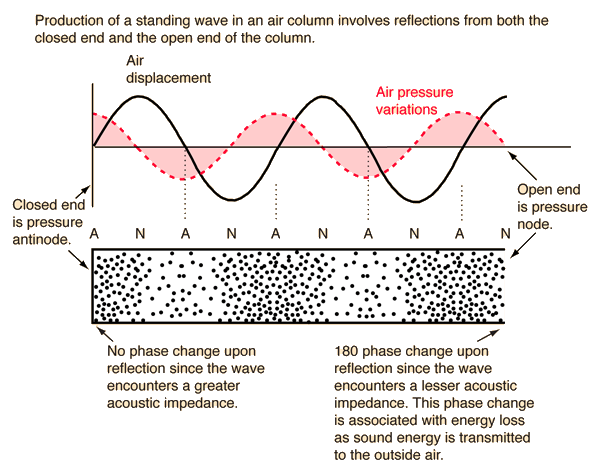
                An open air colunm contains 1/2 lambda at it natural resonance frequency:

                A (one side)closed air column contains 1/4 lambda:


                So, what is the difference between an open end and a closed end??

                As you can see in this picture, in resonating air we have so-called longitudinal waves, waves with pressure differences. The interesting detail is that in areas of high pressure, we have low air displacement:

                Standing Waves


                The same thing goes for E(M) resonances. At places where you have high voltage (high pressure) you have low currents (low movements of the electrons inside your wires) and vice versa.

                In wave terms, one talks about nodes and antinodes. Where you have a voltage node, you have a current antinode. So, at those points at a resonating coil (or wire) where you have high voltages, you have (almost) zero current.

                So, the way you connect your resonating coil determines wether you have a voltage or a current node at the terminal. When you connect a terminal to ground or some component with a more or less fixed voltage and that can draw (relatively) high current, you get a current node. When you leave it open or only use a small couple capacitor to steer a transistor, the voltage can vary as it pleases while (practically) no current can flow, so you get a voltage node.

                So, in theory, you can use 1/4 as well as 1/2 lambda antenna's, depending on how you connect them to your reciever. But in practice, the connection to the receiver will always draw current, so you can only use 1/4, 3/4, .... antenna, since the other end is open and thus has to be a voltage node. Unless of course, you would connect both ends of the antenna to your reciever. In practice, in that case, you would just take two 1/4 lambda antenna's in series and use the current node in the middle to feed to your receiver, which is called a dipole antenna: Dipole antenna - Wikipedia, the free encyclopedia .

                So far, so good.


                There are two main differences between resonating air (or liquid) columns and EM resonators (coils). The first one is that with air, you only have those longitudinal pressure variations, while with EM stuff, you have both an electric longitudinal component as well as a magnetic component. The electric component is basically the same thing as the air analogy in the ether, while the magnetic component adds a rotational component to the ether movements. The second one is that air moves inside your pipe, your waveguide, while the electric component (electric field) moves outside your wires, your waveguide. So, while air resonance phenomenon and the workings of musical instruments offer great insights, there are differences that make the electric stuff a complicated matter and actually there are not that many people that really understand the electric stuff, because they don't really understand what the electric and magnetic fields really are like. So, one more time:
                • The electric field is a pressure-like longitudinal wave traveling trough the ether, just like sound waves travel trough the air.
                • The magnetic field is a rotation, a vortex, a spinning flow trough the ether.


                Normally, the electric and magnetic component associated with EM phenomena go hand in hand, but they are two distinct phenomena which can be (almost completely?) separated. Take for example a magnet and an electret. The first one only gives you a "static" magnetic field, while the latter only gives you a "static" electric field.

                While I think it is impossible to completely separate the electric and magnetic fields in any dynamic situation, you can manipulate the proportion between these fields, for example by using bifilar wound coils or wind dual layer coils, with one layer wound clockwise and the other counter clockwise, as Kapagen did: http://www.energeticforum.com/115135-post1341.html

                Anyway, these two fields (magnetic, (di)electric) can propagate in two distinct ways trough a coil. The magnetic component, the one that has to do with rotation, only travels round and round along the coil wire, just as you expect the current to flow. The electric component can travel in that direction, but also "jump over" from one winding to the next, so travel perpendicular to the coil wires. So, that part of the wave jumping from one wire to the next gives you such a longitudinal pressure-like wave in the length direction of the coil:

                The L.M.D./T.E.M.Test

                Now the coil windings are both magnetically and capacatively coupled to one another. The magnetic component is purely magnetically coupled and sort of drags the electrons in the adjacent wires along in the direction of the wire, while the electric field just jumps from one winding to the next, where the electrons spiral around the coil wire. So, for the EM component, the electrons travel in the direction of the coil wire, while for the pure electric component, they just spiral around the wire.

                The interesting thing is that you can influence the propagation of these two components across your coil by means of the geometry of the coil, the height/diameter ratio:


                For example, if a particular coil has a velocity factor of 1.72, this in effect means that:
                *) The 1/4 wave frequency will be 72% higher than that predicted for its straight wire.
                *) A signal entering the coil will appear at the other end as if it had travelled the wire at 1.72 times the speed of light.
                *) If we imagine the EM signal to be spiralling along the coil, the pitch of this spiral would be 72% greater than that of the winding.
                Here's a graph of this so-called velocity factor:


                So, the difference between a straight wire and a wire wound as a coil is that the EM wave traveling along the coil wires appears to travel at a speed greater than the speed of light for normal single-layer wound coils with a h/d ratio greater than about 0.5-1 (judging from the picture). Since the 1/4 lambda frequency will thus be higher for a given wire length, you can get by with a shorter wire length and still get the resonance frequency you desire.


                What is very interesting in this picture, is the left part. There it shows that the relative propagation velocity goes to zero for pancake coils. That means that for very flat coils, the magnetic component propagates at a speed lower than the speed of light, which means that these kind of coils have a lower 1/4 lambda resonance frequency for a given length of wire....


                For example Stanley meyer talked about matching the wavelength o the movement of the ions... How would you do that in a mm gap? While he was saying that he was using 5khz or so?

                I think theres might be something else on this don't you?

                Why on a guitar string the vibrations for audio frequencies is visible? Is it related with wavelength?

                I was thinking like if what they meant (tesla, stan) were about make electrons behave as waves somehow.
                This is getting interesting. What you have here is two kinds of resonance. You drive the coils using E(M) resonances in your coils. But, the water is not driven into E(M) renance! It resonates acoustically! So, the water is in between capapacitor plates that are covered by a thin dielectric (insulating) layer, so no externally applied current actually flows trough the water. What happens is that the electric field in between the capacitor plates acts upon the ions inside the fluid at a frequency that corresponds to the acoustic resonance frequency of the liquid column in between the plates. And you can actually use two acoustic resonances within your WFC. One perpendicular with respect to the capacitors plates (a pretty high frequency, a distance of a few mm with a speed of about 1,484 m/s ( Speed of sound - Wikipedia, the free encyclopedia ) and one in the length direction of your WFC pipes, just as with organ pipes.

                So, to make a long story short: when you wind a wire as a coil, your antenna appears to be longer for a given wire length. And inside you WFC there is no EM resonance, but acoustic resonance...
                Last edited by lamare; 11-15-2010, 10:42 AM.

                Comment


                • #83
                  Originally posted by DrStiffler View Post
                  @Goldfinder

                  Was the transistor of which you speak the 'Fogal Transistor'?

                  http://blog.hasslberger.com/docs/CHA...TECHNOLOGY.pdf
                  Jigbuy posted an interesting document here, which may give us some hints:


                  It is a document listing what technologies are to be Secretized by the panel at the Pentagon that looks at every Patent Application.... de-classified via the "Freedom of Information Act".


                  Page 14 says the following:

                  Item 5: A device which will convert heat energy directly (statically) into electrical energy by means of two dissimilar metals or semi-conductors formed into a closed circuit and maintaned at different temperatures (AF) (AMC)8/78(NAVY)(AEC - only if Radioactive Material is used).
                  So, apparantly, you can do some interesting things with semiconductors in combination with radioactive material. And of course they know what can be done with this, cause otherwise, they wouldn't know this would be worth keeping secret

                  Comment


                  • #84
                    I hope this is a good place to post this.

                    Oscillations and Regenerative Amplification using Negative Resistance

                    Electrolytic heater - Google Patent Search

                    Method and apparatus for preventing ... - Google Patent Search

                    Fractal antennas and fractal resonators - Google Patent Search

                    Method and apparatus for an ambient ... - Google Patent Search

                    Method and system for energy ... - Google Patent Search

                    System and method for charging ... - Google Patent Search

                    Oh, don't forget to follow those references and citatations
                    Last edited by sigzidfit; 11-15-2010, 12:28 PM.
                    A Phenomenon is anything which can be apprehended by the senses.

                    Comment


                    • #85
                      Off topic or did we ever got on topic?

                      I'll try once more.

                      Dr. Stiffler did state that his exciter does some magic w/ the aether and opens a gate into the aether to some extent and the transistor he uses does this. After looking at his test results w/ the thermo tests etc. it appears there is some additional heat energy. This was on topic. What we don't have is why does this particular transistor work as it does?

                      Now we have have everyone trying to match acoustics w/ electromagnetics. Won't happen guys!

                      Here is the reason - Acoustics moves matter (air guys, matter, mass particles, you know about air I presume, those little things like oxygen, nitrogen, etc.) which moves the aether. Moving vibrating mass causes perturbations in the aether. And what are vibrations in the aether sans any EM, ans. gravitational waves. this is why John Keely's (1890s) acoustics would cause some very fantastic phenomena! It is just harder to use air as its wavelength changes w/ temp and air pressure and gas mixtures.

                      You can also generate gravitational waves by beating two EM waves 180 degrees out of phase which creates a stress wave in the aether. The EM cancels out and the energy goes into aether as gravitational stress waves (see Beaden stuff). And I pointed this out an apparently no one got it. It can also be done by creating a gradient in the E field (Paul Stowe).

                      Now I've answered your conundrum so lets try once more to get back to semiconductor materials. What is different about the transistor that Dr. Stiffler is using?

                      And why do certain semiconductors convert gravitational stress waves into EM?

                      Goldfinder

                      Comment


                      • #86
                        Originally posted by Goldfinder View Post
                        I'll try once more.

                        Dr. Stiffler did state that his exciter does some magic w/ the aether and opens a gate into the aether to some extent and the transistor he uses does this. After looking at his test results w/ the thermo tests etc. it appears there is some additional heat energy. This was on topic. What we don't have is why does this particular transistor work as it does?

                        Now we have have everyone trying to match acoustics w/ electromagnetics. Won't happen guys!

                        Here is the reason - Acoustics moves matter (air guys, matter, mass particles, you know about air I presume, those little things like oxygen, nitrogen, etc.) which moves the aether. Moving vibrating mass causes perturbations in the aether. And what are vibrations in the aether sans any EM, ans. gravitational waves. this is why John Keely's (1890s) acoustics would cause some very fantastic phenomena! It is just harder to use air as its wavelength changes w/ temp and air pressure and gas mixtures.

                        You can also generate gravitational waves by beating two EM waves 180 degrees out of phase which creates a stress wave in the aether. The EM cancels out and the energy goes into aether as gravitational stress waves (see Beaden stuff). And I pointed this out an apparently no one got it. It can also be done by creating a gradient in the E field (Paul Stowe).

                        Now I've answered your conundrum so lets try once more to get back to semiconductor materials. What is different about the transistor that Dr. Stiffler is using?

                        And why do certain semiconductors convert gravitational stress waves into EM?

                        Goldfinder
                        Might consider looking into 'Epitaxial' - Metalorganic vapour phase epitaxy - Wikipedia, the free encyclopedia

                        Comment


                        • #87
                          I don't know but maybe answer is in DOPING ? why military electronics are different then for us , ordinary people ?

                          Comment


                          • #88
                            Associating frequency with length can only be relevant if we know the speed. Do aether speed is the same as electron speed?

                            From energy capturing point of view, I think there must be spesific length that is resonant to both electron speed and aether speed.

                            For me, pulse width is important for any semiconductor implementation at least for health purposes if you don't believe resonant. Pulse width usually related to frequency on many solid state implementation.

                            Moray need to turn dials to turn on his device, I think achieving resonant is necessary.

                            Comment


                            • #89
                              Originally posted by sebosfato View Post
                              I would like to explain to you all what zero point energy really is.

                              It is nothing more than the very small but still existent vibration witch atoms will still have even under 0k absolute temperature.

                              Is too small indeed.

                              Just to let you know what it really is.

                              Many talk about this, in my opinion is a misconception to say you will extract energy from this.

                              Zero field also for me is a wrong lable.
                              To me, it's not too important what ZPE exactly is. What is really important is that every charge carrier in the Universe gets fed by some form of energy from the vacuum, be it ZPE, virtual particle flux, orgone or whatever you want to call it. It doesn't really matter. What matters is that these charge carriers emit energy in the shape of an electric field, cause that is energy in a usable shape. Prof. Turtur explained that very nicely:


                              Important is the conclusion, which can be found with logical consequence:
                              On the one hand the vacuum (= the space) permanently supplies the charge with energy (first paradox aspect), which the charge (as the field source) converts into field energy and emits it in the shape of a field

                              Comment


                              • #90
                                Originally posted by Goldfinder View Post
                                I'll try once more.

                                Dr. Stiffler did state that his exciter does some magic w/ the aether and opens a gate into the aether to some extent and the transistor he uses does this. After looking at his test results w/ the thermo tests etc. it appears there is some additional heat energy. This was on topic. What we don't have is why does this particular transistor work as it does?
                                What it does is put a coil into resonance using a very high bandwidth, which means fast switching. Very sharp edges. And that means you get higher harmonic resonant oscillations in your coil. And that means you get multiple nodes and antinodes in your coil. And because of Bearden's "don't kill the dipole" and the fact that the energy that is in the electric field is emitted by your charge carriers for free, you can deduce that you only have to drive one of these nodes of these high harmonic standing waves yourself, while the ether provides the energy to keep the other nodes going for free.

                                So, it comes all down to resonance and thus wave mechanics.


                                Now we have have everyone trying to match acoustics w/ electromagnetics. Won't happen guys!

                                Here is the reason - Acoustics moves matter (air guys, matter, mass particles, you know about air I presume, those little things like oxygen, nitrogen, etc.) which moves the aether. Moving vibrating mass causes perturbations in the aether. And what are vibrations in the aether sans any EM, ans. gravitational waves. this is why John Keely's (1890s) acoustics would cause some very fantastic phenomena! It is just harder to use air as its wavelength changes w/ temp and air pressure and gas mixtures.
                                What is the difference between waves trough the ether and waves trough a fluid? If you want to understand waves trough the ether, it really helps to understand waves trough a fluid or air first. Cause the electric component works the same way, just a different medium, one you can't see. Once you understand how this works in air/fluids, it is much easier to understand how this works in the ether.

                                By the way, it is possible to use EM fields to vibrate atoms in a fluid, which is what IMHO really is what is going on with Meyer's WFC. By getting the fluid into acoustic resonance by exciting the fluid with EM fields, you can apparantly get water to split into hydrogen and oxygen, where you pull the energy out of the ether using higher harmonic resonances in coils.

                                You can also generate gravitational waves by beating two EM waves 180 degrees out of phase which creates a stress wave in the aether. The EM cancels out and the energy goes into aether as gravitational stress waves (see Beaden stuff). And I pointed this out an apparently no one got it. It can also be done by creating a gradient in the E field (Paul Stowe).
                                So, you kill the magnetic component that way, exactly as what you can do by winding a dual layer coil, with one layer wound clockwise and the other counter clockwise. What you get then is a longitudinal electric wave, which gradient apparantly is what gravity is.


                                Since the gradient of a sine is a cosine, gravity waves apparantly are the same thing as longitudinal electric waves, right?

                                Now I've answered your conundrum so lets try once more to get back to semiconductor materials. What is different about the transistor that Dr. Stiffler is using?
                                IMHO, his transistor just switches extremely fast, causing lots of these higher harmonic resonating oscillations in your coil. See above. IMHO, it is not absolutely necessary to use extremely fast switching in order to get energy for free out of these higher harmonic oscillations, as long as you get your main coil into higher harmonic resonance. However, the higher harmonics you use, the better. So, it does work better and more efficient using fast switching, which is why spark gaps are often use in FE devices. But the principle by which you get this FE is in the higher harmonics, not in the switching as such, nor in the use of a spark gap as some are suggesting elsewhere.
                                Last edited by lamare; 11-16-2010, 07:47 AM.

                                Comment

                                Working...
                                X