

 Tweet
Tweet
Originally posted by scratchrobot
View Post
I stumbled up on a website with information which exactly explains what we are looking for. Since Romero confirmed he used bucking coils and pointed to the Kromrey effect he must have used Scalar current, or normal current supplied trough the two wire going down the hole in the table.
Scalar Current by Moray B. King
One of the most unusual claims associated with certain "free energy" devices is the ability to conduct appreciable power on ordinary thin wires without heating them. To an electrical engineer this result is extraordinary and it would constitute a definitive demonstration of a novel form of electromagnetism. Here is suggested an experiment that could produce "cold conduction" and demonstrate an hypothesized phenomenon known as "scalar current."

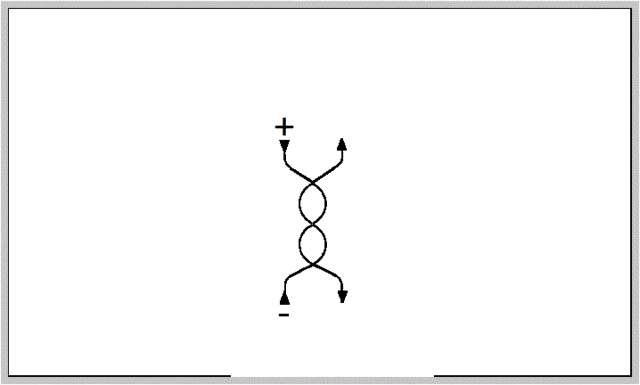
Scalar current arises by abruptly bucking magnetic fields onto a caduceus wound or a bifilar wound coil (Figure 1). If bucking magnetic fields are impressed onto an ordinary, single wound coil, no current would flow since the magnetic fields cancel. However, impressing these fields onto a caduceus or bifilar coil would allow two oppositely flowing "virtual" currents to occur because, by symmetry of the windings, the opposite current vectors sum to an effective zero current. The currents are described as "virtual" since they are comprised not of electron flow in the wires, but rather a displacement current in the vacuum zero-point energy outside the wire. It is as if the abruptly bucking magnetic field manifested a pair production of two macroscopic, oppositely rotating, displacement current vortices in the zero point energy.' These vacuum energy vortices are stabilized and supported by the two symmetric wind ings.
There are many ways to impress the abruptly bucking magnetic fields onto the caduceus or bifilar coil. One method could use two electromagnets with the proper control circuitry to appropriately phase the magnetic fields. In another method the coil could be spun in the air gap between two opposing permanent magnets using brushes and slip rings to tap the scalar current (Figure 2).

Bedini described using this method in his "gravity field generator" where he not only reported "cold conduction" but also a weight change in the apparatus as well.2 A third method could shift the bucking fields onto the coil by either physically oscillating opposing permanent magnets or shifting their field by variable reluctance techniques.3 Obviously any method that resulted in shifting a bucking magnetic flux onto the caduceus or bifilar coils could be utilized in this experiment.
The experimenter could also explore how to best combine the current in the opposite windings. The windings could remain separate or be combined in series or parallel (Figures 3 and 4). Another option could add a second caduceus (or bifilar) coil in the air gap at the opposite poles of the bucking magnets so that both ends of the alternating bucking magnets are launching scalar currents (e.g. Figure 2). These two sets of coils could then be combined appropriately to keep the currents in phase to maximize the output.
An attractive attribute of this suggested experiment is its simplicity. It is hoped that those working with these ideas freely share their results for it will expedite the development of a new technology.
Capacitive Discharge Motor and other free energy files - J Snell
Scalar Current by Moray B. King
One of the most unusual claims associated with certain "free energy" devices is the ability to conduct appreciable power on ordinary thin wires without heating them. To an electrical engineer this result is extraordinary and it would constitute a definitive demonstration of a novel form of electromagnetism. Here is suggested an experiment that could produce "cold conduction" and demonstrate an hypothesized phenomenon known as "scalar current."
Scalar current arises by abruptly bucking magnetic fields onto a caduceus wound or a bifilar wound coil (Figure 1). If bucking magnetic fields are impressed onto an ordinary, single wound coil, no current would flow since the magnetic fields cancel. However, impressing these fields onto a caduceus or bifilar coil would allow two oppositely flowing "virtual" currents to occur because, by symmetry of the windings, the opposite current vectors sum to an effective zero current. The currents are described as "virtual" since they are comprised not of electron flow in the wires, but rather a displacement current in the vacuum zero-point energy outside the wire. It is as if the abruptly bucking magnetic field manifested a pair production of two macroscopic, oppositely rotating, displacement current vortices in the zero point energy.' These vacuum energy vortices are stabilized and supported by the two symmetric wind ings.
There are many ways to impress the abruptly bucking magnetic fields onto the caduceus or bifilar coil. One method could use two electromagnets with the proper control circuitry to appropriately phase the magnetic fields. In another method the coil could be spun in the air gap between two opposing permanent magnets using brushes and slip rings to tap the scalar current (Figure 2).
Bedini described using this method in his "gravity field generator" where he not only reported "cold conduction" but also a weight change in the apparatus as well.2 A third method could shift the bucking fields onto the coil by either physically oscillating opposing permanent magnets or shifting their field by variable reluctance techniques.3 Obviously any method that resulted in shifting a bucking magnetic flux onto the caduceus or bifilar coils could be utilized in this experiment.
The experimenter could also explore how to best combine the current in the opposite windings. The windings could remain separate or be combined in series or parallel (Figures 3 and 4). Another option could add a second caduceus (or bifilar) coil in the air gap at the opposite poles of the bucking magnets so that both ends of the alternating bucking magnets are launching scalar currents (e.g. Figure 2). These two sets of coils could then be combined appropriately to keep the currents in phase to maximize the output.
An attractive attribute of this suggested experiment is its simplicity. It is hoped that those working with these ideas freely share their results for it will expedite the development of a new technology.
Capacitive Discharge Motor and other free energy files - J Snell
This is something I read about a while ago. looks like it is very good idea
and need time devoted to it.

if you could keep us posted on any thing. would be great.
cheers


Comment