This forum is preserved as a permanent archive. The community continues at eMedia Press.

Announcement

Collapse
No announcement yet.

The essence of the physical effect of generating free energy from the secondary field

Collapse
X
 
  • Filter
  • Time
  • Show
Clear All
new posts

  • The essence of the physical effect of generating free energy from the secondary field

    Like to start from the BackGround and then on the top of this thing.
    This is related only to FerroMagnetic effect of generating free energy from the secondary field.

    First step: BackGround

    Downloadable .pdf document Step ONE

    * Downloads | FerroMagnetic

    We go Step By Step until 10th of July The BirthDay of Nicola Tesla
    (i like to do and if all goes ok)

    .
    Last edited by Guntis; 07-01-2011, 02:56 AM.

  • #2
    Makes sense to me !

    Hi guntis, The first step make's complete sense to me, and I have tried to explain this aswell, if you are saying what I think you are saying I agree with you competely. That the input current does not directly contribute to the magnetic field or rather that the magnetic field contains greater energy than the input power minus the power that flows to ground through the primary coil.

    Looking forward to step two.

    Cheers

    Comment


    • #3
      Originally posted by Farmhand View Post
      Hi guntis, The first step make's complete sense to me, and I have tried to explain this aswell, if you are saying what I think you are saying I agree with you competely. That the input current does not directly contribute to the magnetic field or rather that the magnetic field contains greater energy than the input power minus the power that flows to ground through the primary coil.

      Looking forward to step two.

      Cheers
      That way i start from the Groud for clear without messups to be clear about physical effects and then way up to polish it with HV and how to organize all process on commutation with quasi-resonant interval and so on...

      Step By Step
      Last edited by Guntis; 07-01-2011, 05:58 AM.

      Comment


      • #4
        Originally posted by leochbattery
        Do you know the chemical secret of lead acid battery? Although these batteries have been used for over 150 years, I believe most people don't know their principle.

        Comment


        • #5
          Guntis

          Can you explain in simple words what is that document about ? In plain English. My English is simple and not complicated but this document need a language expert.

          Maybe you should edit this document ?

          Comment


          • #6
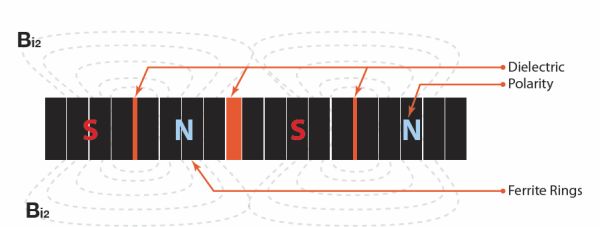
            With a dielectric in between, looks like you end up with a one pole magnet. Is this correct?

            Respectfully,

            Core
            Attached Files

            Comment


            • #7
              Originally posted by Core View Post
              With a dielectric in between, looks like you end up with a one pole magnet. Is this correct?

              Respectfully,

              Core
              Just wanted to re-phrase my comment.

              With the thin dielectric in between the ferrite rings how do you end up with a solid 'S' & 'N' pole? This would imply that you have a one pole magnet. I believe I am mis-reading this. Due to the dielectric break why wouldn't you have two magnetic fields on the left side?

              Respectfully,

              Core

              Comment


              • #8
                Originally posted by leochbattery
                Do you know the chemical secret of lead acid battery? Although these batteries have been used for over 150 years, I believe most people don't know their principle.
                If you have something like this to share,
                please do start a new thread on this
                and tells us what you know about this.

                Comment


                • #9
                  Originally posted by Guntis View Post
                  Like to start from the BackGround and then on the top of this thing.
                  This is related only to FerroMagnetic effect of generating free energy from the secondary field.
                  You may want to check out the work of the German Prof. Claus Turtur:


                  He explains the basic theory of how both the "static" magnetic field and the electrostatic field actually convert ZPE into these fields and that is where free energy eventually comes from. I have referred to him in my "article" over at pes:

                  Article:Free Electric Energy in Theory and Practice - PESWiki

                  Last edited by lamare; 07-03-2011, 10:19 AM.

                  Comment


                  • #10
                    Originally posted by Core View Post
                    With a dielectric in between, looks like you end up with a one pole magnet. Is this correct?

                    Respectfully,

                    Core
                    we are dive in this too, but there are some wider areas to think about, not only electronic part but questions about...
                    Ok, i ask you "Magnetic energy is electronic part of this device or this is kinetic energy?"

                    Comment


                    • #11
                      Originally posted by Guntis View Post
                      "Magnetic energy is electronic part of this device or this is kinetic energy?"

                      Well I'm really not sure. The magnetic field on the Bi2 core is a result of the kinetic energy from the 'magnetizer' core. With the dielectric split in the core waves are transmitted through the dielectric into the Bi2 core. To create a magnetic field in Bi2 core the 'magnetizer' core would have to be close or at its resonant frequency of the material to be strong enough to transfer through the dielectric.
                      Core Bi2, when vibrating, would create a magnetic field. These vibrations would cause the domains to align creating the field. I would imagine that this would be no different then striking a steel rod with a hammer to magnetize it.

                      So from what I see the kinetic energy from 'magnetizer' coil influences the Bi2 core to vibrate at a frequency that aligns the domains on its core. I guess another example would be two tuning forks of same pitch and weight influencing each other. So it would appear that the wave passing though the dielectric can do additional work while not adding to the work of the source.

                      If anything I said is correct then it would appear that the same procedure can be completed with other materials such as steel, iron, etc. The difference being the amount of energy required to 'jump start' the process. I guess in this case ferrite is ideal.

                      I really don't know.

                      Respectfully,

                      Core

                      Comment


                      • #12
                        What happened?

                        -Core

                        Comment


                        • #13
                          Downloads | FerroMagnetic

                          Design Of Device Step 2 final


                          ...And help us God to all for free

                          Comment


                          • #14
                            Originally posted by Guntis View Post
                            Downloads | FerroMagnetic

                            Design Of Device Step 2 final


                            ...And help us God to all for free

                            Is this a pure theoretic excercise, or do you have (witnessed) working examples?

                            Because as far as I understand this, you plan to use fixed static magnets to create a magnetic field to be picked up by a coil. If that is to be the principle, you would have to create a varying magnetic field, otherwise your coils cannot pick up the energy that is actually there, but wasted into space.

                            Anyway, may be this is helpful for you too:

                            Originally posted by lamare View Post
                            I got that.

                            What I meant to say is that up to a certain degree, you can describe electro-magnetism using basically the same things as used in hydraulics. Some "thing", a fluid, flows trough some other "thing", a tube or water hose, a pump, etc. And actually 99% of electrical engineering uses this hydraulic analogy, where you can safely neglect the fact that underneath the surface, everything is really a wave (pattern), a very dynamic system.

                            And yes, you are right, you can also explain wave dynamics such that they can be understood to a degree without being too complicated, but only once you completely understand what is going on yourself.

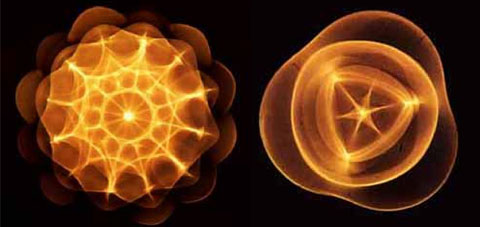
                            What is very confusing with the current theory and thus the accompaning vizualisations is that we have been taught the electric field, the magnetic field and the gravitation field are three completely separate phenomena, which are connected in mysterious ways. In actual fact, they are not. This cymatic picture has told me very much:


                            You see some clear structure being formed as a result of just one phenomenon: sound waves in a liquid. If you imagine the little ball in the middle of the left picture being the earth and you know that the highlighted area's that form the structure in the cymatic picture are some kind of grains of some kind of material, it is clear that gravity must be a result of ether waves and not something mysterious. Of course, most of the structure is invisible in the real world, because you can only "see" the structure because of the grains in the liquid, but I am convinced the same kind of structure as seen on the picture actually surrounds the earth in the ether.

                            Finally, one comes to the following conclusion:
                            1. The gravity field is the pressure-variation of the ether
                            2. The electric field is the speed of the uni-directional movement of the ether
                            3. The magnetic field is the speed of the rotational movement of the ether

                            Comment


                            • #15
                              Originally posted by lamare View Post
                              Is this a pure theoretic excercise, or do you have (witnessed) working examples?

                              Because as far as I understand this, you plan to use fixed static magnets to create a magnetic field to be picked up by a coil. If that is to be the principle, you would have to create a varying magnetic field, otherwise your coils cannot pick up the energy that is actually there, but wasted into space.

                              Anyway, may be this is helpful for you too:
                              No static magnets, it uses HV HF modulated rings and by triggering these fields
                              you can move these rings horisontaly across the ferrite core and by moving it
                              cause to spin ferrite domains in ferromagnetic matereal by this moving rings
                              effect happening work who produces 50Hz frequency (depending on speed of moving rings)
                              speed of movement causes to produce this Low Voltage Low frequency.

                              it is fully tested near year. and i have witness that this device is fully
                              working aparatus to produce electric power and it has capabilities to feed itself with that power.

                              Comment

                              Working...
                              X