This forum is preserved as a permanent archive. The community continues at eMedia Press.

Announcement

Collapse
No announcement yet.

Here's looking at Euclid (Bogart)

Collapse
X
 
  • Filter
  • Time
  • Show
Clear All
new posts

  • #61
    Hi Duncan
    I love this thread and all that you have presented so far.
    However the last post bothers me a bit. I worked for a large machine manufacturer designing and troubleshooting the electrical systems. I have seen many a motor failures.
    On every occasion it could be broken down to a few different things. Most common was that the installer would supply to small of a supply line to handle the amps needed to avoid a voltage drop for the lengh of wire run needed. Second would be a bad connection somewhere within the system also causing high amperage and voltage drop. Or you could have a simple situation of overloading the motor again causing high amperage and voltage drop. Of coarse all of these situations create heat and something burnt out. A properly set up system will usually run for years.
    This is my own observation, but maybe I still am not understanding the situation. Are you saying that we need to create a situation of high amperage and low voltage?
    I stand ready for correction.

    Comment


    • #62
      Duncan,

      Simple question : do you know and can explain what is radiant energy ?

      Zardox : can you easily explain why the subsequent run of motor not so long time after turning it off consume much less input power ? It looks like electric motor has a "cold" and "heated" state exactly like an engine.

      Comment


      • #63
        Originally posted by Zardox View Post
        Hi Duncan
        I love this thread and all that you have presented so far.
        However the last post bothers me a bit. I worked for a large machine manufacturer designing and troubleshooting the electrical systems. I have seen many a motor failures.
        On every occasion it could be broken down to a few different things. Most common was that the installer would supply to small of a supply line to handle the amps needed to avoid a voltage drop for the lengh of wire run needed. Second would be a bad connection somewhere within the system also causing high amperage and voltage drop. Or you could have a simple situation of overloading the motor again causing high amperage and voltage drop. Of coarse all of these situations create heat and something burnt out. A properly set up system will usually run for years.
        This is my own observation, but maybe I still am not understanding the situation. Are you saying that we need to create a situation of high amperage and low voltage?
        I stand ready for correction.
        Whatever you can do,or dream you can,begin it.Boldness has genius,power and magic in it.Begin it now.

        Comment


        • #64
          Originally posted by boguslaw View Post
          Duncan,

          Simple question : do you know and can explain what is radiant energy ?

          Zardox : can you easily explain why the subsequent run of motor not so long time after turning it off consume much less input power ? It looks like electric motor has a "cold" and "heated" state exactly like an engine.
          Hi Boguslaw ... luckily "Radient energy" is in the lexicon's and so there is no need for me to explain anything .. however here's a very simplified description which should explain it for you with out to much stress on the english
          What is radiant energy
          kind regards
          Whatever you can do,or dream you can,begin it.Boldness has genius,power and magic in it.Begin it now.

          Comment


          • #65
            FAQs about Surge Arresters for High Voltage Substation Applications - YouTube
            Last edited by Duncan; 06-05-2013, 11:35 AM.
            Whatever you can do,or dream you can,begin it.Boldness has genius,power and magic in it.Begin it now.

            Comment


            • #66
              Relics !

              Originally posted by iflewmyown View Post
              Are you talking of the synchronous motor instead of capacitors for phase correction?
              (so this Zardox is why I was pointing to very high circulating currents)

              For those with a RF or electronics background this then is effectively an "acceptor circuit"

              Synchronous condenser : Ac Motors
              Last edited by Duncan; 06-05-2013, 12:20 PM.
              Whatever you can do,or dream you can,begin it.Boldness has genius,power and magic in it.Begin it now.

              Comment


              • #67
                Good afternoon,
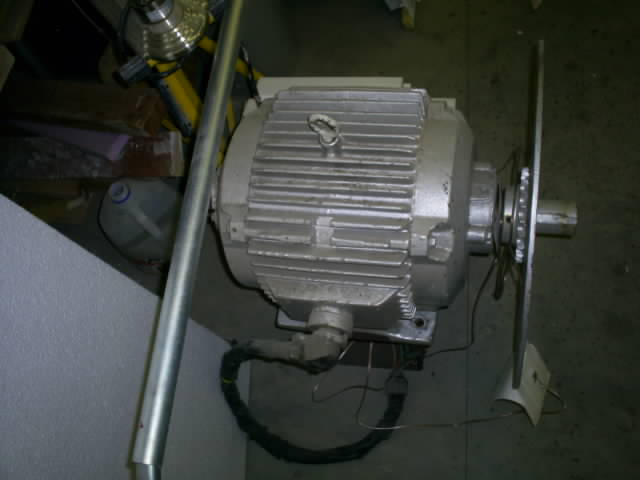
                This is a picture of a motor I converted to a wind turbine generator. It has the original 3 phase winding and a new rotor. The rotor was machined to a double octagon and 16 2" x 2" x 1/2" magnets epoxied on. The whole rotor was then wound with fiberglass filament and epoxy. The original was 15 hp and at the slow speed the turbine ran max output was about 1800 watts. I spun the rotor up to 800 rpm when it was new just to see if it would hold together before sticking it into the air. I don't know if it will withstand 1750 synchronous speed or not. It might be a receptor for reactive power ??
                GarryClick image for larger version

Name:	S4021533.JPG
Views:	1
Size:	27.8 KB
ID:	454812

                Comment


                • #68
                  OK , I am beginning to get a picture. At least in theory anyway.

                  Comment


                  • #69
                    Originally posted by iflewmyown View Post
                    Good afternoon,
                    This is a picture of a motor I converted to a wind turbine generator. It has the original 3 phase winding and a new rotor. The rotor was machined to a double octagon and 16 2" x 2" x 1/2" magnets epoxied on. The whole rotor was then wound with fiberglass filament and epoxy. The original was 15 hp and at the slow speed the turbine ran max output was about 1800 watts. I spun the rotor up to 800 rpm when it was new just to see if it would hold together before sticking it into the air. I don't know if it will withstand 1750 synchronous speed or not. It might be a receptor for reactive power ??
                    Garry[ATTACH]13341[/ATTACH]
                    Nice job Garry ... seems a shame to destroy it before it ever gets to do the job you made it for ... or is that the welding upside down up a pole thing?
                    It which case ....
                    Whatever you can do,or dream you can,begin it.Boldness has genius,power and magic in it.Begin it now.

                    Comment


                    • #70
                      Here is part of my theory.....This modulated high frequency current, which you depicted Duncan, (if modulation is pure sinewave or other periodical but not sharply changing) is what I believe exactly so called "cold electricity". For all resistive loads it is like a slow frequency current but indeed it is HF having skin effect so it's more or less harmless. For any other loads it depends on load , because there appear a slower frequencies as an effect of intermodulation. Basically it can be converted to our 50/60Hz by using a filter.

                      Comment


                      • #71
                        Hectors house

                        Originally posted by Zardox View Post
                        OK , I am beginning to get a picture. At least in theory anyway.
                        Roto VerterRotoverter Technology was OU before ORBO one.

                        Here is one of the rotoverter group .. demonstrating the reactive current conversion.
                        Dan Combine 2011: "My video on Non-Linear Resonance" | MERLib.org
                        Whatever you can do,or dream you can,begin it.Boldness has genius,power and magic in it.Begin it now.

                        Comment


                        • #72
                          Gazooks ...

                          Originally posted by boguslaw View Post
                          Here is part of my theory.....This modulated high frequency current, which you depicted Duncan, (if modulation is pure sinewave or other periodical but not sharply changing) is what I believe exactly so called "cold electricity". For all resistive loads it is like a slow frequency current but indeed it is HF having skin effect so it's more or less harmless. For any other loads it depends on load , because there appear a slower frequencies as an effect of intermodulation. Basically it can be converted to our 50/60Hz by using a filter.
                          Whatever you can do,or dream you can,begin it.Boldness has genius,power and magic in it.Begin it now.

                          Comment


                          • #73
                            Well,Duncan if I'm right , for example about "cold electricity" then as you see there is nothing spectacular about it : radio frequency of even Mhz range currents can be produced and modulated and Tesla even mentioned no effect above 10khz afaik. Now compare that to all that mystery layered above simple HF modulated to low frequency current. Sure, I can be wrong , because there may be more then one effect included into the total "cold electricity" statement, like the "frozen wires effect" and so on.... The main trouble is the one statement was used by many inventors describing different devices.

                            Without clearing the mystery part we can talk a lot about magic stories....

                            Comment


                            • #74
                              Duncan, this genny rode a pole for 6 years. It is expendable. The new one is a geared grid tied 10KW over driven induction motor.

                              Comment


                              • #75
                                Don't Fret

                                Originally posted by iflewmyown View Post
                                Good afternoon,
                                This is a picture of a motor I converted to a wind turbine generator. It has the original 3 phase winding and a new rotor. The rotor was machined to a double octagon and 16 2" x 2" x 1/2" magnets epoxied on. The whole rotor was then wound with fiberglass filament and epoxy. The original was 15 hp and at the slow speed the turbine ran max output was about 1800 watts. I spun the rotor up to 800 rpm when it was new just to see if it would hold together before sticking it into the air. I don't know if it will withstand 1750 synchronous speed or not. It might be a receptor for reactive power ??
                                Garry[ATTACH]13341[/ATTACH]
                                Gary,
                                Epoxy is stronger than you know. I have a SSG with a 6" rotor. Two 7/8" thick pieces of particle board with a hard drive rotor sandwiched between them. Six 1x2x1/2 magnets epoxied on the outside of the boards. After about a year of running, I wrapped some nylon reinforced packing tape around the rotor. Has been running for over 2 years at around 2500 rpm. I would say your genny will hold up just fine.
                                Randy
                                _

                                Comment

                                Working...
                                X