-
Sincerely,
Aaron Murakami
Books, Videos, ESTC Conference Info, Blog, etc. https://emediapress.com
-
Hi Aaron!
Not sure I've ever posted here despite joining back in like 2007. Anyways, I've just finished my own version of Mike Water's design that my daughter shot a little video of with her cell phone. https://youtu.be/X_hSOutOOiI -
Waters Turbine
Thanks for the link - that looks pretty slick!Originally posted by grumblenuts View Post
Do you have any close up pics of how you built it?
Any way you can datalog the output with wind speed an electrical output to see what it is really doing?Sincerely,
Aaron Murakami
Books, Videos, ESTC Conference Info, Blog, etc. https://emediapress.com
Comment
-
Thanks! Nah, not yet anyway. Just built the darn thing, sheesh! Lol. Pics? I designed it in SolidWorks13 format. U know me. Dumpster polycarbonate, bearings, axles, scrap skid 4x4, wheel leftover from old magnet experiment, drywall screws, paint. Cost to me? $0 < what I happen to have in me wallet as well, coincidentally,... tee hee.
It does run quietly (when no trucks are going by), smoothly, and steadily with any wind. It also produces some interesting reflections like a spinning disco ball.Comment
-
Btw, the image on your book cover is pretty much how I've pictured the best design all along. Only I wonder whether adding some ridges spiraling out from the center might help accelerate the "fluid" through the blades with less turbulence.


Comment
-
Still no generator or torque measuring yet (no money), so obviously I can't corroborate Mike's claims other than it starting with the slightest breath of wind. However, I watch the thing a lot and it sure appears to work great. It snaps to attention when actual gusts of wind come along and quickly accelerates as though the flywheel has no mass. It's impressed me so much I've already drawn up a bigger version with what I see as some slight improvements.

May build that next year... But that's not all by a long shot. My mind keeps shooting out to infinity and beyond...Comment
-
Mike Water's Turbine
Behind the turbine is a vacuum, does the tail your using work as expected and keeps the turbine facing the wind?
--------------------------------------------------
Here is a reference on Mike Water's page:
Waters Turbine - A Cure For Global Crises
Velocity Profile
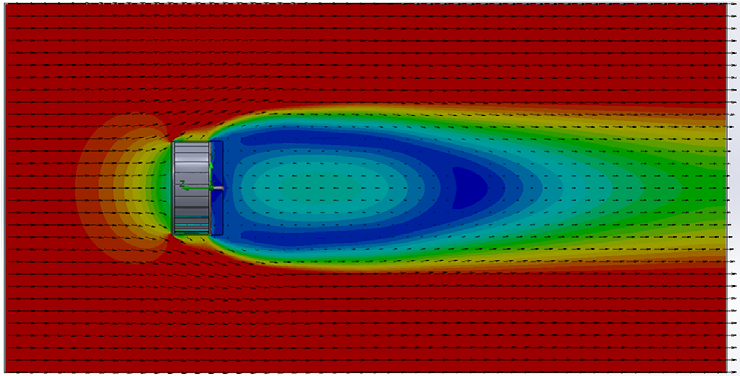
Third party and direct comparison test
There have been three separate third party tests, including computer flow analysis. My own direct comparative tests against a conventional high performance wind turbine in a broad range of conditions confirm theory. We ran direct comparisons in real world conditions for days because 3rd party results seemed too high. One result was well over 30 times. An aerodynamicist study over several months of tests found a maximum of 122 times more efficient at 14 mph.
The conventional design was a molded precision product with an accurate airfoil. Mine was far from optimized, using no airfoils in order to build at low cost. Comparing my 4' design against a stock 5' three blade, under the same load, the conventional product starts at over 7 mph and produces very little torque or rpm at that speed. My turbine, under the same load starts at under 1 mph. If the square force relationship is used that is 49 times more force required to turn the conventional design. If the cube rule is used the difference is 343 times. Then there is a size difference. The actual formula is more complex and varies with wind speed but the results are interesting. Startup velocity is just one factor but this shows that a much broader wind velocity range can be utilized.
In analyzing many wind turbine polars, real world generator efficiency range usually results in electrical output falling somewhere between square and cube relationship.
Another interesting data point, under extreme shaft load, the conventional turbine would not turn, even at 28 mph. My design in the same conditions self starts at 11 mph.
Test equipiment involved a prony brake, rpm meter and wind meter. Accuracy of both wind and rpm meters was within 5%. Prony brake measurements were comparative and direct, utilizing the same shaft, load and conditions for both designs.Sincerely,
Aaron Murakami
Books, Videos, ESTC Conference Info, Blog, etc. https://emediapress.com
Comment
-
Hi Aaron.
Thanks for the infos and rigour You've made the tests, even still raw design Trying to understand perfectly something, observing by one's self to check the truth, is the only way to skills and to protect oneself from false data and rumors.
Comment
-
Mike Waters turbine
Hi Khwartz,Originally posted by Khwartz View Post
All credit goes to Mike Waters as I'm only copying what he has posted.
This is one of the most practical disruptive technologies that has been put in front of the public's awareness and I'd love to see a lot of replications.Sincerely,
Aaron Murakami
Books, Videos, ESTC Conference Info, Blog, etc. https://emediapress.com
Comment
-
Agreed, Aaron. All credit goes to Mike. You're just spreading the word and I've simply replicated a portion of his work to somewhat test the idea independently.
It appears to work just fine. Nonetheless, we're free to consider other angles. Thinking will out. Can't be stopped. Dammit!
Yes, it does. Great question. I really like keeping things "simple stupid." So does it really need a tail? Is it worth the bother? I don't know. As you note, there is a vacuum behind. I think widening its wind capture diameter by adding to the forward flange as I've shown could only help. But what if it were flipped? Remove the tail now and it still follows the wind. Would it work as well? I don't know!Behind the turbine is a vacuum, does the tail your using work as expected and keeps the turbine facing the wind?Comment
-
hello %Aaron and hello grumblenuts.
So that's nice you replicate it grumblenuts so you could provide real independent measurements.
Regards
DidierTrying to understand perfectly something, observing by one's self to check the truth, is the only way to skills and to protect oneself from false data and rumors.Comment
-
Comment
-
Around 7PM with wind noticeable but relatively calm - I measured 3-6 inch-pounds of static (or starting) torque with my handy little Snap On Torque-O-Meter - the one I damn near gave away long ago, having never found any practical use for it, and recalled possessing only this morning. I'd say it measured 5 inch-pounds on average ranging mostly from -5 to +20 with rare bursts reading +25 and higher.
And I ordered a cheap anemometer so I'll soon be noting the wind speed accurately. In case anyone's moved to do some calculations, the windmill's diameter (outside) is 33" (and 28" inside). The vent ring is 6.5" deep.Comment
-
Well, figuring on a default 5 in-lb/s output, my back of napkin calculations tell me that:
1. My 33" diameter version will produce virtually no power most of the time, at least where I live in PA, somewhat surrounded by buildings and tall trees.
2. But, if I build the one drawn above, 130" diameter, I can expect it to output about 1/20th hp or 35 watts in its default state.
The bigger one, in other words, may stop turning occasionally in the cool, dewy calm before the dawn (Winter especially), but it will generally keep a 35 watt bulb shining brightly. Not sure there is such a thing, but it would keep a decent battery charged at least.
However,... when it gets a little windy... look out!
Comment
-
As time marches inexorably on, there's this saying, most often attributed to the author of Winnie the Pooh, to ponder: "Sometimes I sits and thinks, and sometimes I just sits."
I continue to monitor this windmill daily. pondering myriad tests, additions, modifications, variations, ... But I swear, sometimes it just keeps on spinning with no apparent wind, other times there seems to be wind and it just sits.
Mostly though, I remain amazed at just how well the damn thing works. Had this design been thought of first, I believe it likely that those touting the stuff we've always seen, especially the popular "lift" based models, would have simply been laughed at and faded away into obscurity. Ironically, it seems the opposite remains the prevailing wisdom for now.Comment

This forum is preserved as a permanent archive. The community continues at eMedia Press.
- If this is your first visit, be sure to check out the FAQ by clicking the link above. You may have to register before you can post: click the register link above to proceed. To start viewing messages, select the forum that you want to visit from the selection below.

 Tweet
Tweet
 12,000% More - Open System Physics & Thermodynamics by Mike Waters

Comment